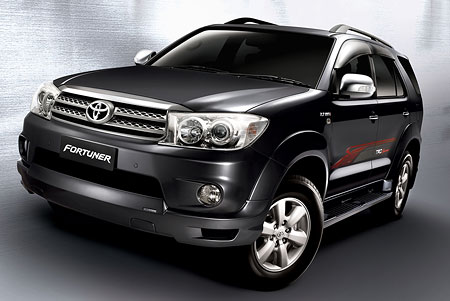
The Toyota Fortuner, also known as the Toyota Hilux SW4, is a medium-sized SUV based on the Toyota Hilux. Originally assembled only in Thailand, but later also in Indonesia and other countries, the Fortuner is built on the well-established platform of the Toyota Hilux pickup truck. It features three rows of seats and is available in rear-wheel drive or four-wheel drive among others. The Fortuner is part of Toyota's IMV project in Thailand, which also includes the Toyota Hilux and the Kijang Innova (in Indonesia). The car was designed in Thailand by Thai and Japanese engineers. A number of engine options is available depending on the country of sale, including a 2.7 liter 2TR-FE and 4.0 liter 1GR-FE V6 petrol with Variable Valve Timing and 2.5 2KD-FTV and 3.0 1KD-FTV common rail variable geometry turbocharger Diesel models. Trim levels are G and G Luxury for rear-wheel drive diesel and gasoline, and V for four-wheel drive Diesel and gasoline. The common rail turbo intercooled diesel has functional scoop on its hood. In 2007 Toyota Thailand dropped the four-wheel drive gasoline model and replaced it with a two-wheel drive gasoline version. This car was the best selling in its category (SUV/PPV) in the Philippines and currently Thailand. The Fortuner is not offered in Japan, Europe and North America, where the Hilux Surf is for the Japanese market and 4Runner in North America represent Toyota in the medium sized pick-up based SUV market. In Argentina, it is sold as Toyota Hilux SW4The Fortuner was unveiled in South America - Colombia in 2005 and launched in 2007. There are various models out and Toyota released a new model in 2010 - Fortuner Urbana (Gasoline 2.7 4x4 and 4x2). The Fortuner was unveiled in South America - Ecuador in 2005 and launched in 2007. Versions of the Fortuner have come from Venezuela and Thailand. There are various models released, originally only 4x4 and 4x2 options using a V6 4.0 liter petrol engine were sold. Since 2010 a 2.7 liter engine option has been released and the new face lift model has arrived. The Toyota Fortuner was very popular and successful with Ecuadorian drivers since it was released in 2007, until late 2009. Since 2010 the Ecuadorian government has exempted all hybrid cars from import taxes, which reduced the number of Fortuner cars sold greatly due to the fact that Toyota purchasers prefared Toyota´s Hybrid Highlander Limited which has a similar price and has more and better stand out features. Nevertheless Toyota continues to sell the Fortuner mainly because there is still a niche of drivers how are looking to own a true 4x4 car with chassis, something that the Highlander Hybrid does not have and because the Highlander Hybrid is not designed to be driven off-road. Two trims are available for 2011 - 4x4 and 4x2 - both sporting the 4.0 V6 engine. The assembly plant is located in Cumaná, Venezuela.The Fortuner was unveiled in South Africa in 2005 and launched in 2006. There are various models out and Toyota released a new model in 2009.Toyota launched the Fortuner in Pakistan in 2009.

Toyota launched the Fortuner in India in 2009. It is assembled at the Bidadi, Karnataka plant of Toyota Kirloskar Motor Private Limited from imported CKD kits. The much anticipated SUV has been a runaway success for Toyota. The Fortuner was initially supposed to be launched in 2005, but Toyota took time to bring it to India. The Toyota Fortuner has clocked over 10,000 units so far in sales, and has become the best seller in its segment. The company had increased production to more than 950 vehicles per month from the initial 500 units per month, but is still finding it difficult to meet demand. Within 9 months of its release in India, Toyota Fortuner broke sales records and Pre delivery stats. In May 2010, Toyota suspended bookings for Fortuner SUV. The company said its suspension of bookings will continue till the waiting period reduces to three months. There is only one variant sold in India of the Fortuner, which is the 3000cc Common Rail Turbo Diesel engine, with leather upholstery and climatronic as standard. Though the waiting period has come down to 3 months now, it is still selling at a premium, white being the most preferred color of choice. The Fortuner was introduced in 2005 at the Jakarta International Motor Show. It is positioned below the Land Cruiser and the RAV4. Initially the Fortuner was sold in 2.7 G and 2.7 V trim levels. The rear wheel drive 2.7 G was offered in the base with fabric interior and the Luxury with leather interior and premium sound system. The 4-wheel drive Fortuner 2.7 V is only available as the luxury model. The V trim with the 3.0 diesel engine is not officially sold in Indonesia, due to the heavier tax regulations imposed on vehicles with 4x4 drivetrains and engines having volumes of 3000cc or more. It was specially imported for the Sumatra and Kalimantan markets, where it became a strong seller. The 2.7 G is fitted with a 4-speed automatic transmission and a two-wheel drive with a 2694 cc petrol engine. This model is a strong seller in big cities because of its automatic transmission. The 2.7 V adds four-wheel drive, and is popular outside Java, where off-road and bumpy roads predominate. The rear wheel drive 2.7 G and 4x4 2.7 V come only with automatic transmission. The 2.5 G was later added to the market, powered by a 2.5 diesel engine giving 102 bhp (76 kW; 103 PS), criticized for being underpowered for its size. It is mated to a 5-speed manual. Its high body model has been criticized as unstable, and not aerodynamic when running at higher speeds. Despite this, 2.5 Fortuner enjoys success regardless of only available with a manual transmission, because the Toyota brand is trusted by many Indonesians. Moreover, the 2.5 diesel engine is considered more efficient and durable in the long run. In mid 2009, a new variant was added to the lineup, which is the 2.5 G with a 4-speed automatic transmission. Current owners of the 2.5 G with manual transmission criticized the model, saying that the manual was already very underpowered, and adding an automatic transmission would only make matters worse. Despite such criticism, Toyota hopes this model would be a best seller and would bring up sales of the Fortuner which was weakening, because the current best selling model, the 2.5 G with manual transmission aren't selling very well because at that price the market wouldn't pay for a manual transmission car, so the introduction of an automatic transmission would definitely be suitable for the market. The 2.5 G can be ordered with TRD Sportivo body kits, which is also available as dealer installed options for other models. At its launch the Fortuner sold well, but it never outsold the Honda CR-V and Nissan X-Trail because these SUVs are more efficient and are regarded as being superior for urban use. In rural areas the Fortuner is popular since it can accommodate many people. The current President of Indonesia, Susilo Bambang Yudhoyono privately owns a gray Fortuner in V guise, and was often seen during the recent campaigns for the 2009 presidential election.

The Toyota Fortuner is sold in Malaysia in 2 variants – 2.7V and 2.5G. The 2.7V carries a 4-cylinder, in-line 16-valve, DOHC, VVT-i petrol engine, with a maximum output of 118 kW (160 PS; 158 hp) at 5200 rpm and maximum torque of 241 N·m (178 lb·ft) at 3800 rpm. 2.7V is available only in 4-speed automatic transmission with ECT. The 2.5G has a DOHC Turbo diesel engine with a maximum output of 75 kW (102 PS; 101 hp) at 3600 rpm and maximum torque of 260 N·m (190 lb·ft) at 1600-2400 rpm. 2.5G was initially available with a 5-speed manual transmission only, but for the 2009 model year facelift it has been replaced by a 4-speed auto. The Fortuner was introduced in 2005 to supplant the RAV4 and the Land Cruiser. It is sold in 3 variants: 2.7G gasoline, 2.5G diesel, and 3.0V diesel. The 2.7 G model is equipped with Toyota's 2.7-liter 2TR-FE engine with VVT-i technology, which produces 160 hp (119 kW) at 5200 rpm and 241 N·m (178 lb·ft) of torque at 3800 rpm. The 2.5G model, on the other hand, is equipped with the 2.5-liter 2KD-FTV engine with common rail diesel (D-4D) technology, which produces 102 HP at 3600 rpm and 260 N·m (190 lb·ft) of torque at 1600-2400 rpm. The 3.0V, which is the top variant, is the only 4X4 model in the range (previous variants are both 4X2). It is equipped with the 1KD-FTV engine with D-4D technology, which produces 163 hp (122 kW) at 3400 rpm and 343 N·m (253 lb·ft) of torque at 1400-3200 rpm. The 2.5L 4X2 diesel variant comes in both manual and automatic transmissions, while the rest comes in automatic transmission only. The facelifted Fortuner was introduced in November 2008, together with the facelifted Innova and Hilux. The Fortuner has been recently overtaken by Mitsubishi's Montero Sport in overall sales, and currently faces stiff competition from newer SUV models like the Ford Everest, Hyundai Santa Fe, and Kia Sorento. There have been rumors, but have not been confirmed that an all new version is expected in the 2012 models. Sources close to Toyota deny this. They say They always announce their new Models through their Dealer network. As of now the current models are the Latest with the all new Facelift last Year. The Fortuner is Selling well and no changes are expected in the near future. The Fortuner was introduced in 2005 and was immediately popular with SUV buyers. The problem was finding a place for this SUV in the urban jungle of Singapore. Some problems include parking since it has a staggering height of 1.85 meters and some car parks cannot accommodate that height. The 2009 model is now out and to this day fewer than 1000 in Singapore exist.The Fortuner is available with two engines, the 158HP rated 2.7L or the 235HP rated 4.0L.A minor redesign of the Toyota Fortuner was launched in August 2008 for 2009 model year. It features new projector headlamps and grille, new rear lights, bluetooth connectivity, new light sand interior, electronic adjustable driver seat in 4x4 V trim, rear cool air conditioning from ceiling for second and third row. Electronic Brake Force Distribution, with Brake Assist replacing LSPV in some models only. It is also All Wheel Drive (AWD) for the first time. Its newly redesigned front grille and front lamps are in the style of the Toyota Land Cruiser 200 Series. There are basically four models; 2.5 G 4x2, 2.7 G Luxury 4x2, 2.7 V 4x4, and 3.0 G 4x4.


 Active Lexus RX 350 In Black
 In 2006 for the 2007 model year, the RX received a mid-cycle refresh consisting of a new 3.5-liter 2GR-FE V6 replacing the 3.3-liter 3MZ-FE V6 engine on non-hybrid models, updating the vehicle's name from RX 330 to RX 350, with new model codes GSU30 and GSU35. In 2007 for the 2008 model year, the RX received a revised grille, chrome door handles, available new seven-spoke 18-inch alloy wheels, and new exterior choices.
 Lexus RX 350 Engine
 At the 2007 Tokyo Auto Show, the LF-Xh concept was unveiled, hinting at the styling direction of the next RX. Later in November 2008, the redesigned third generation RX premiered at the Greater Los Angeles Auto Show, appearing as the standard RX 350 (GGL10/GGL15) and hybrid RX 450h (GYL10/GYL15). The Japanese market Toyota Harrier was discontinued, with previous generation sales held for several months following the third generation's debut.
 Lexus RX 350 Luxury Interior With Classic Design
 Lexus RX 350 Doors Concept
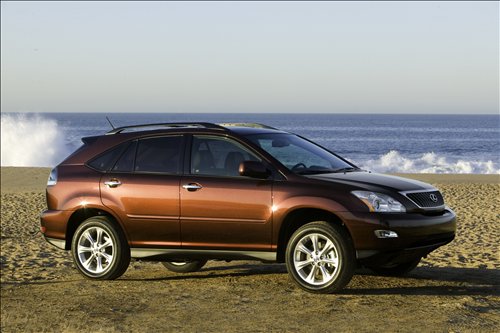 The redesigned RX 350 features a revised 3.5-liter 2GR-FE V6 engine producing 275 horsepower (205 kW) with a wider power curve, it remains ULEV-II certified and now uses a six-speed automatic transmission with sequential shift. A double wishbone rear suspension setup replaces the previous MacPherson strut design for improved handling and greater cargo space, while an optional Sports Package adds a performance-tuned suspension. Both non-hybrid and hybrid models continue in either front or all-wheel drive configurations, with the all-wheel drive system gaining Active Torque Control for greater efficiency, and all models are built off the new midsize flexible K-platform. American RX 350 sales began in February 2009 as a 2010 model.